
In the early 1990s, hardcore began to attract the interest of A&R departments at prominent record labels in New York City and Los Angeles.
Sick of It All were playing packed-out clubs all over the globe, Bad Brains had found a new home at Epic Records, Quicksand had a buzz building, and Biohazard were fusing NYHC grit with hip-hop swagger. Suddenly, the same labels that once ignored hardcore began cutting checks to bands who were used to releasing their music on small indies.
The '90s major label signing wave started in New York. In 1993, Bad Brains signed with Epic Records, marking their first major-label venture. The result was Rise, an album that showcased a shift in their lineup, with Ras Israel Joseph I stepping in as the new vocalist and Cro-Mags' drummer Mackie Jayson joining the fold.
"When we were talking about the record deal thing, we decided that the best thing for the band, and the best way to spread the rastafari message, was to be on a big record label," Israel revealed in a No Echo interview back in 2017. "I was the one really pushing for that.
"Being young, I had this new vision like, 'Man, small labels are great, but you've been doing that for years. We gotta do something big now and blow it up!'"
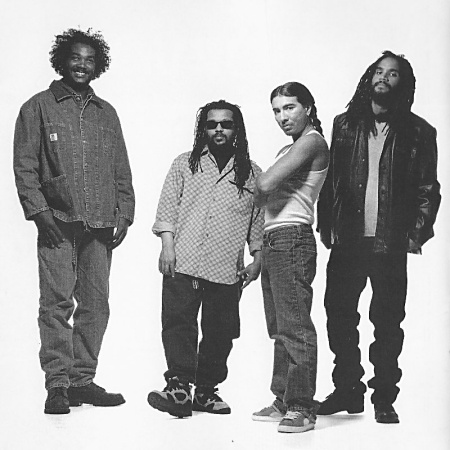
Rise didn't do much commercially, and both Israel and Jayson were out of the band. Bad Brains then welcomed back their original vocalist, H.R., and drummer, Earl Hudson, back into their lineup. The band struck a deal with Maverick Records, a label founded by Madonna. Their 1995 release, God of Love, was produced by Ric Ocasek, the late great Cars guitarist/vocalist who had also been behind Weezer's smash debut album the prior year.
Ocasek had first worked with Bad Brains on Rock for Light, the group's 1983 sophomore album. Maverick's marketing efforts weren't enough to propel God of Love into any kind of commercial success. It didn't help that H.R. was getting into all kinds of trouble during their touring campaigns.
Sick of It All were the ultimate hometown heroes, and after a couple of underground classics for Relativity/Combat, they inked a deal with EastWest/Elektra for 1994’s Scratch the Surface.
Sick of It All vocalist Lou Koller spoke with Norman Brannon about their experience in a 2024 interview on Anti-Matter. ""We did two records for [EastWest]. After that, they sat us down and they said, 'We want to talk to you about doing two more albums with us. We like what you do.'
"They called us a 'sub-gold band,' which meant we weren’t making gold records, but they also weren’t losing any money. They made money off us, so they wanted to keep us. But we didn’t want to stay."
Both Scratch the Surface and its 1997 follow-up LP, Built to Last, didn't veer away from Sick of It All's musical style and lyrical direction. Their music video for “Step Down” found regular airplay on MTV’s Headbanger’s Ball, helping to introduce a generation of metalheads to NYHC along the way:
Not far behind came Biohazard, who jumped from Roadrunner (a "big indie" itself) to Warner Bros. after their sophomore album, Urban Discipline, caught fire.
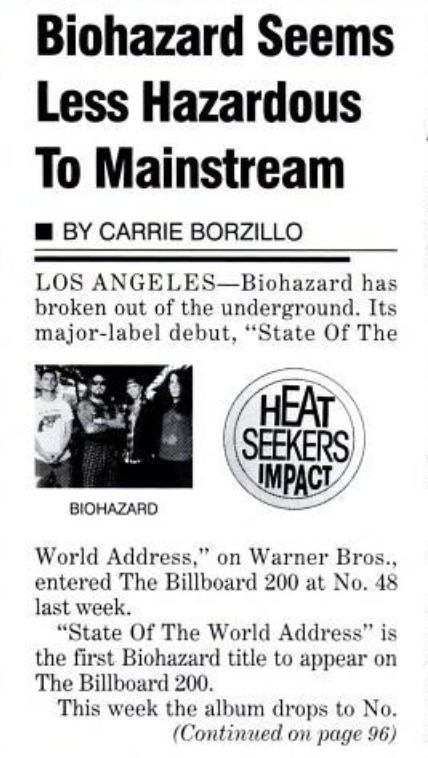
To help promote 1994's State of the World Address, Warner Bros. had a 1980 Chevy Malibu, adorned with the Biohazard logo, driving throughout Southern California, where reps from the label distributed materials to promote cross-marketing between the band and several social justice organizations.
State of the World Address was the first Biohazard album to appear on the Billboard 200 chart, landing in the 48th spot during its debut week.
While NYHC bands were muscling their way in, a different strain of hardcore was sneaking through the side door. Featuring musicians who had already played in such hardcore bands as Gorilla Biscuits, BOLD, and Absolution, Quicksand took the melodic, textured side of hardcore and landed a deal with Polydor for 1993’s Slip.via A&R executive Joe Bosso. That record became a touchstone for a generation of bands who wanted to color outside the lines.
After switching over to Island Records, Quicksand released another post-hardcore classic with 1995's Manic Compression. Following Quicksand's break up, guitarist/vocalist Walter Schreifels eventually formed Rival Schools.
Island Records still had right of first refusal on Schreifels and decided to release Rival School's debut album, United by Fate, in 2001.
Once the door cracked open, the signings came fast.
Comprised of three-quarters of Gorilla Biscuits, CIV dropped Set Your Goals on Atlantic in 1995, complete with a hook-friendly single (“Can’t Wait One Minute More”) that wound up in a Nissan commercial.
I interviewed CIV bassist Arthur Smilios in 2016, and I asked for his take on their label partnership:
"There were some great people who worked at Lava/Atlantic back in the '90s, who really cared about music and the artists, and my experience with them was enjoyable. That being said, coming from punk/hardcore, I never felt at home with the corporate climate. I am not going to malign anyone, but suffice it to say, if I could do it over again, I would have stayed with an independent label. Working with Jordan Cooper and Revelation Records again feels right. We are of the same culture and there is a tacit understanding between all of us."
The signings continued. Sheer Terror joined MCA’s roster and released Love Songs for the Unloved in 1995, hoping to bring their beloved ugliness to a bigger stage. Even influential '80s hardcore heroes 7Seconds made the leap, cutting The Music, The Message for Sony in 1995.
Out of Los Angeles, downset. fused hardcore and hip-hop-influenced vocal cadences, and record labels heard the sound of cash registers ringing. "The demo went out to labels and there was a feeding frenzy," downset. bassist James Morris told me in a 2017 No Echo interview.
"There were people who thought that the mix of hip-hop with heavy music was the next big thing. We were sold as something like Black Flag with Ice Cube in the mix, or something. That’s what A&Rs were saying."
Ultimately, someone with hardcore pedigree named Alec Peters working at Mercury Records—home to Bon Jovi and KISS at the time—snatched up downset. "He was an O.G. Boston hardcore guy," Morris told me. "He knew everyone in the hardcore scene there. I think he was Gang Green’s tour manager at some point.
"As an A&R, I know he signed the Mighty Mighty Bosstones and Circle Jerks. He had a lot of success with the Bosstones. Mercury, at that time, was trying to get away from the Bon Jovis and stuff like that. The label was learning what do with a band like us as we went."
downset. would release two albums on Mercury—1994's self-titled debut album and 1996's Do We Speak a Dead Language?—before joining the Epitaph Records artist roster.

Shift, a NYC post-hardcore band that had been on Equal Vision Records, signed to Columbia for their second album, releasing Get In in 1998. "I don’t truly regret anything because that’s pointless—we were who we were at that point in our lives—but I certainly have a lot of things I would probably do differently if I could do it all over again," Shift guitarist/vocalist Joshua Loucka said about his experience inking with Columbia in a 2018 No Echo interview.
"It may be not be like this now, but signing to a major is one of those things that is really hard to say 'no' to. People are telling you 'you could be a really big band' and it’s hard not to get caught up in the excitement. You think, 'yeah, maybe I am supposed to be a rock star. [Laughs] Maybe I really am [Def Leppard singer] Joe Elliot.”
"But in retrospect, we gave it a shot and it didn’t work, and it’s kind of as simple as that. Some of the reasons it didn’t work were our fault and some were other people’s faults and then there’s also just the fact that major labels put out a lot of records and if you don’t show them quickly that you’re going to make them a lot of money, they move on."
Staying in the NYC lane, Orange 9mm included players who had been in bands like BURN, Fountainhead, and Zero Tolerance. Their propulsive post-hardcore sound attracted the attention of Mike Gitter of Atlantic Records who signed the band for their 1995 debut album, Driver Not Included.
Gitter was himself a hardcore music lifer, both as the writer behind xXx Zine in the '80s, and a musician in the bands Grin and Apology. Other bands Gitter has signed throughout his A&R career include Bad Religion, Samiam, Killswitch Engage, and DragonForce.
Formed in 1990 in New York City, Into Another featured members from Underdog, Youth of Today, and BOLD. They released their first two studio albums on seminal hardcore label Revelation Records, blending post-hardcore muscle with prog-rock-like instrumental passages.
In 1995, Into Another signed with Hollywood Records and released Seemless. Produced by Rick Parashar (Pearl Jam, Blind Melon) the album's single, “T.A.I.L.,” reached No. 39 on the U.S. Billboard Mainstream Rock Tracks chart in 1996.
Nonetheless, internal conflicts and a declining relationship with the record label resulted in the band's dissolution later that year. An album titled Soul Control was recorded but was never officially released.
"The guy who was running Hollywood Records at the time, Bob Pfeiffer, ended up hemorrhaging money for that label and just being an all-around disaster, and we butted heads," Into Another vocalist Richie Birkenhead told Norman Brannon's Anti-Matter about their time on the Disney-owned label in a 2013 interview. He went on to say their major label run was "a slow death" for the band.

Some of these deals made sense, while others felt like shots in the dark from A&R reps desperate to find “the next Nirvana” but with tattoos. Gitter later admitted that “everyone wanted a piece of anything remotely punk or hardcore because grunge had just blown the doors open.”
So did it work? It depends who you ask. Quicksand’s Slip is now a stone-cold classic and still influences young musicians to this day. Sick of It All managed to keep their integrity intact and parlayed their major-label moment into a career that’s still raging three decades later. Biohazard hit gold status, toured the world, and after a long hiatus, will be returning with their 10th studio album, Divided We Fall, this October.
Others weren’t so lucky. Shift’s slick major debut never found its audience. Sheer Terror’s MCA stint was brief and rocky. downset. earned a cult following but struggled to fit into Mercury’s marketing plans. Even the bands who “won” often found themselves fighting clueless promo departments or being dropped the second sales didn’t spike.
“We were used to doing everything ourselves,” Quicksand's Schreifels told Alternative Press years later. “Suddenly you have people telling you what single to release. It was surreal.”

By the end of the decade, the gold rush had cooled. Nu-metal was the next corporate obsession, and hardcore retreated back to its independent roots. But the ‘90s major-label flirtation left a mark. It proved hardcore bands could operate on a bigger stage without watering down their sound. It also gave many of these groups the resources to record definitive albums, tour internationally, and build lifelong followings.
Hardcore never stopped being a DIY culture, and the majors eventually moved on. But for a hot minute in the ‘90s, the underground went overground, and the result was a wild, messy, and unforgettable chapter that proved the scene was bigger and tougher than anyone in a boardroom could imagine.
***
If you're interested in this topic and want to learn more about the era, check out Dan Ozzi's excellent book, Sellout: The Major-Label Feeding Frenzy That Swept Punk, Emo, and Hardcore (1994–2007).

Tagged: 7seconds, 90s hardcore week, bad brains, civ, quicksand, sick of it all