

You would be forgiven if Tennessee’s Serotonin isn’t on your radar. The band existed in its initial run from 1995 until 2002, starting in the college town of Murfreesboro as a four-man unit and eventually moving 45 minutes away to Nashville as a trio. At the time, the South was still a bit overlooked by the greater hardcore world, with the occasional exception like Avail or His Hero Is Gone.
Serotonin’s sound was marked by stark changes, shifting from pummeling riffs to a delicate sweetness and eventually erupting into a screaming bedlam. They belonged to a tradition of bands like Minutemen, Shellac or Drive Like Jehu – acts that have complex, locked-down rhythm sections that let the guitars explore the fringes a little more.
Running around the East Coast and Southeast with a variety of bands like From Ashes Rise, Reversal of Man, Jesuit, and Piebald, the band made a mark with their unique brand of post-hardcore. But they called it quits in 2002, after their drummer was diagnosedwith osteonecrosis in his wrist. They were survived by three albums, one EP, and a couple of splits, but none of the records captured just how powerful they were on stage.
Somewhat secretively, guitarist/frontman Andrew Walker revealed to me a year ago that he had been getting together with bassist Jason Deitz and drummer Jim Valosik. The three had been faithfully jamming once a week, workshopping new songs and relearning their old material. Now fully active again, all three members sat down with me after their first soundcheck in over two decades to talk about Serotonin’s past and present.
So how did you guys find each other to start the band initially?
(Andrew Walker, guitars/vocals): Band t-shirts! We all went to [Middle Tennessee State University.] We all started the same semester at MTSU. So fall of ‘95. And back then, there were a decent amount of kids there that we all ended up connecting with. But how we all found each other was essentially what band t-shirt you were wearing.
(Jim Valosik, drums): Yeah, I had a Discord Records t-shirt on. It had a live Minor Threat shot.
(Andrew): That's how Jason and I both noticed Jim.
That’s such a “'90s hardcore” experience.
(Andrew): Back then, everyone who went to MTSU were locals… Murfreesboro, Nashville… Southerners. And then there was the recording industry program that brought people in who weren't from the local area. And the freaks kind of found each other essentially that way. I moved here from Atlanta. Jason came down from the D.C. area. Then I met my roommate Ryan [Snyder], who also used to be in Serotonin.
He had an Inkwell patch on his backpack. And I was from Atlanta. Inkwell is from Atlanta… It became obvious if I knew who Inkwell was, there's no chance there are many more people that I'm going to connect with. So that's how we became friends and really built from there… Our first show was in February of ‘96.
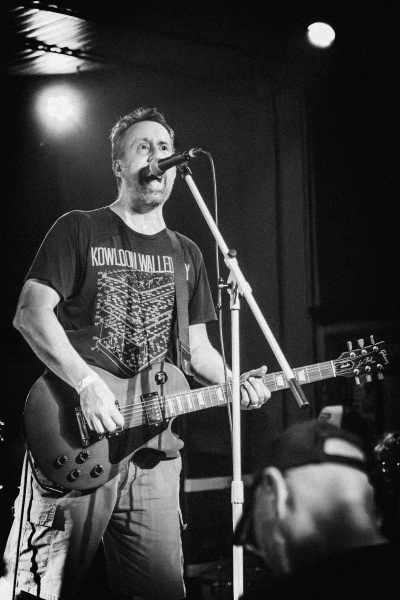
Serotonin toured a fair amount in a time when a lot of bands from the South didn't really get out on the road. Do you think that there was a different relationship to that world if you were a Southern band versus bands from other parts of the country with more established punk communities?
(Andrew): Yeah, it took a lot of effort and sheer will.
(Jim): I think had we been from a big city, it wouldn't have been as hard to get shows… But there was no infrastructure – at least in Nashville and Murfreesboro – besides [Lucy’s Record Shop], for that kind of stuff.
(Jason Deitz, bass): I feel like what helped us out was that [Ryan and Andrew] did house shows… So they had a lot of touring bands coming through because they were doing house shows. And that's how that whole networking thing kind of works… So it's like, “Okay, if we're gonna tour or do something now, we have a connection or someone to get contact info.”
What facilitated you guys getting back together?
(Jim): I didn't think I could play drums anymore after we split up. I didn't play drums for years and I played guitar in bands, but I started getting obsessed with Michael Jackson's drummer. "Sugarfoot" [Jonathan Moffett] is his name. And watching his videos online, I was like, “I want to learn how to play ‘Smooth Criminal’”. This is during COVID. I was like, “I got the time. I'm gonna not hurt my wrist.”
I got to learning more and more songs. And I was actually learning to play a little differently without flailing as much and not hurting myself. Andrew had mentioned that he had a bunch of riffs. So we're like, “Let's get together and at some point – just jam on some of your riffs.” … And we played with Steven Small. He's in the Yammer Jaw. And we played with him for a little while… And then we got Jason back in the mix and quickly realized that it was essentially Serotonin with another person.
(Jason): And I wasn't available to play bass at first, because I was touring with another band.
(Andrew): And quick backstory – Jim's wrist… He couldn't play drums for long because he had his wrist cut. He had a dead bone in his wrist that required tons of surgery… That's why we stopped playing originally…. It’s [now] like – I got all this shit and Jim was like, “I can play drums again.” And then when Jason became available, it was like – this is just Serotonin.
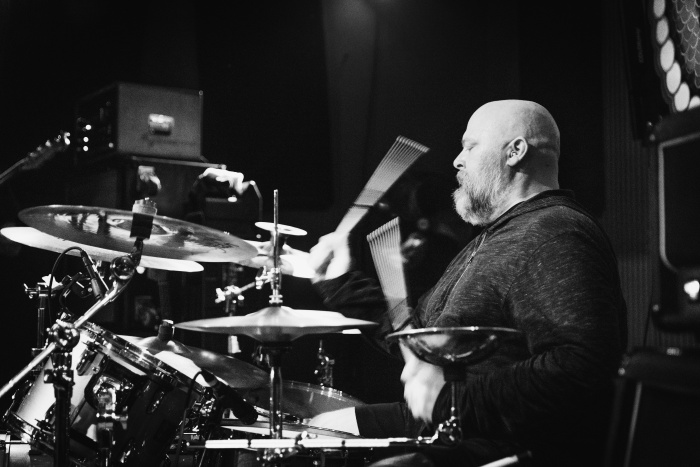
And you have new music that you’re playing. Do you have plans to record it or do anything with it?
(Jim): We recorded seven songs, demo-wise, in Jason’s studio. And then we probably have another… between two and five in the works. Enough to make a full length.
(Jason): We may release one of these songs, but I feel like since we recorded, if we're gonna do it for real. I’ll spend more time getting sounds right.
(Andrew): There's enough content to do another record. There's probably enough content to do another record after that… I think we're having fun just writing songs… It's 15 years, 20 years of like leftover riffs that I have never really played with anybody.
Are there things you relate to differently after taking 20 years off?
(Jim): Just playing the drums themselves. I would consider myself now a pocket player. Before I was like a flailing pounder.
(Andrew): There's one song in particular that's on Future Interior called “Alias” that's about the West Memphis Three case. This is gonna sound familiar... It's about people being rounded up and arrested because of how they look. They're not necessarily guilty. And half the country thinks it's great and half the country thinks it's terrible. And that sounds very familiar to the different scenario that we're in right now. And I realized that all of the lyrics could completely be applied to the illegal immigration thing…
As we were practicing, I was like, “Wow, these lyrics… Because they're vague enough about what I meant for them to be, they can mean something completely different when times change… I kind of like that. I tried to write the lyrics to be kind of like a lot of heavy symbolism to me… But that song in particular, I can see how the meaning of the song had changed when times changed.
***
Serotonin on social media: Instagram
Thanks to Greg Pack for the photos. Check out more of his work on his website, and Instagram page.
Tagged: serotonin