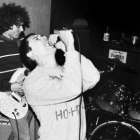

35 years after forming, Converge released new music that ranks among the most impressive and inspired work of their career. Few bands reach that level at such a late stage, let alone twice in the same year. Now that I've had time to live with Love Is Not Enough and Hum of Hurt, I wanted to reflect on what makes them such extraordinary records—and why they belong alongside the defining albums in Converge's storied catalog.
Love Is Not Enough arrived in February, marking the band's first proper full-length since 2017's The Dusk in Us. Four months later came Hum of Hurt, written during the same creative period but carrying a distinctly different personality. As longtime listeners would expect, none of the material relies on nostalgia or self-imitation. Converge sound like a band still evolving, drawing on decades of chemistry while remaining eager to explore new musical possibilities.
That distinction matters because consistency alone doesn't explain these records. Converge have never released a weak album, but Love Is Not Enough and Hum of Hurt feel different. They're not simply excellent late-career releases—they're the kind of albums that immediately demand comparison with the band's defining work. They belong in the same vaunted class as Jane Doe, All We Love We Leave Behind, and Axe to Fall.

For most veteran bands, that would be an impossible claim. Converge prove otherwise.
Converge's career since 2001 has inevitably been viewed through the lens of Jane Doe, the album that reshaped metallic hardcore and influenced generations of bands. Every release since has faced the same question: Does it measure up?
The comparison is understandable, but it also misses the point.
You Fail Me was colder and more minimal. No Heroes was lean and relentless. Axe to Fall expanded the band's sound through a long list of collaborators, while All We Love We Leave Behind paired overwhelming heaviness with emotional clarity. The Dusk in Us leaned further into the atmospheric side of the quartet's sound.
Converge never tried to make Jane Doe twice. Instead, they built on its defining qualities—restlessness, emotional honesty, rhythmic unpredictability, and complete commitment—while continuing to sound as vicious as they did when I first saw them live in the '90s.
In a 2018 interview with No Echo, bassist Nate Newton recalled that Jane Doe was the first time the band felt capable of fully realizing its collective vision.
"We felt like we could really flex our creative muscles the way we wanted to. It was the first time we were able to actually accomplish what we were conceptualizing."
Newton also remembered worrying that the songs on Jane Doe were too diverse to form a cohesive record before the band assembled them through what he described as "Tetris-like" work. That willingness to embrace contrast remains one of Converge's defining strengths. Their records can move from hardcore to sludge, noise, melody, and near silence without losing their identity.

Although Love Is Not Enough, produced by Kurt Ballou, and Hum of Hurt, produced by all four members of the band, emerged from the same writing sessions, they never feel like halves of a divided double album.
Love Is Not Enough songs like the title track, "Distract and Divide," and "To Feel Something" feature straightforward arrangements (at least according to Converge standards) while Jacob Bannon addresses institutional failure, technological isolation, addiction, mortality, and the limits of good intentions.
I still remember hearing the album's second track, "Bad Faith," for the first time and instantly texting several friends about how incredible it was. Over a writhing Koller-Newton rhythmic bed, Ballou throws a guitar riff clinic, while Bannon shifts from a venomous snarl into a desperate, higher-register howl that perfectly captures the song's sense of desperate urgency.
The album's title summarizes its central idea: love still matters, but sentiment without action cannot protect people or repair the damage around them.
Speaking with Treble, Bannon explained that compassion and empathy require constant effort rather than passive belief. "Sometimes we forget to be kind. We forget to be all the things that can raise a society, a family, a friendship."
The album gradually shifts gears after the murky instrumental "Beyond Repair." The songs become slower and more expansive, allowing clean vocals, melodic guitar lines, and open space to amplify the impact of the heavier moments.
The Needle Drop observed that Love Is Not Enough isn't simply a return to the chaos of Jane Doe or You Fail Me, but one of Converge's most direct records in years, emphasizing intensity, clear messaging, and hardcore punk energy.
Hum of Hurt approaches those same strengths from another angle.
A crush of guitars and distorted bass washes over the album, creating the sensation of a physical mass pressing against the listener. Nate Newton's bass frequently moves to the forefront, particularly during the opening of "Dream Debris," where a single note hangs in the air like approaching machinery.
Pitchfork called Hum of Hurt the "darker and more brooding sibling" of Love Is Not Enough and suggested it "may be the heaviest album Converge have made."
That intenisty comes less from nonstop speed than from deliberate pacing, cavernous grooves, and the space left between impacts. Ballou's guitar often floats above the rhythm section in sheets of noise before everything locks back together. Ben Koller's drumming never feels technical for its own sake, reminding me of Shellac's Todd Trainer at points, while Bannon expands his vocal approach through moments of startling clarity.
Kerrang! described the record as "more artful, more textured, more considered" than its predecessor while emphasizing that it remains equally feral. The magazine also noted that, despite sharing the same writing period, the albums establish entirely separate identities.
Ballou later explained why splitting the material made sense. "We wanted every song to have the best chance it had to be heard."
He was right.

One word appears repeatedly throughout the critical response to these records: vitality.
Pitchfork called the most intense moments on Love Is Not Enough "refreshing evidence of Converge's vitality." The Needle Drop praised the album for showing more guts than many younger bands. Kerrang! found it remarkable that Hum of Hurt could equal its predecessor while sounding so different.
Ballou has often spoken about authenticity over expectation. That philosophy explains how Converge could collaborate with Chelsea Wolfe on Bloodmoon: I, return with the lean attack of Love Is Not Enough, and then follow it with the denser, moodier Hum of Hurt without any of those decisions feeling calculated.
"No part of me is anticipating, 'What do the people want?' It's all about, 'What do I want?'"
That outlook echoes what Newton told No Echo about Jane Doe. Converge made that record on their own terms, unconcerned with whether listeners or labels immediately understood it. That confidence has never left them.
Perhaps Jane Doe will always define Converge's legacy. Landmark albums become inseparable from the moment listeners first discover them, and no later release can recreate that experience. Just look at bands like Metallica, Smashing Pumpkins, and Interpol for examples of this idea.
But a band's legacy shouldn't be measured solely by whether it surpasses its most famous record. The better question is whether it can still create music worthy of standing beside it.
With Love Is Not Enough and Hum of Hurt, Converge have done exactly that. They aren't preserving a legacy or revisiting past triumphs. 35 years into their career, they're still adding new peaks to one of heavy music's greatest catalogs.
***
Love Is Not Enough and Hum of Hurt are available via Epitaph Records.

Tagged: converge