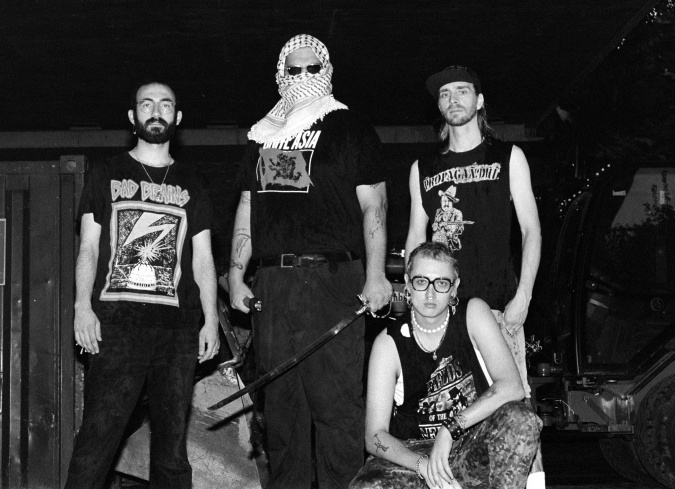
Snake Eater are one of the more striking newer bands to emerge from the Dutch hardcore underground, not just because of how vicious their music sounds, but because of the political and personal weight they bring to it. The band formed in 2024 and quickly moved from stompy, punk-driven hardcore toward a more metallic, grind-influenced attack, pulling from the likes of Nails and Racetraitor while channeling the urgency of a scene that could use more bands willing to say something real.
Their recently released standalone single, "P***," and EP, 2026 پرومو, plus late 2025's Al-Hakam EP, are fierce musically, but they’re also rooted in anti-imperialist politics, labor struggle, and the experience of carrying multiple identities within a subculture that often talks a good game about inclusion without always making space for it.
For Snake Eater vocalist yaar-e-Aly, the band is inseparable from his experience growing up as a Dutch-Pakistani kid in the Netherlands, as well as from a broader political worldview shaped by South Asian revolutionary poetry, solidarity work, and the realities facing people in Pakistan and across the Global South.
I reached out to yaar-e-Aly to talk about the band’s origins, the meaning behind Al-Hakam, why Snake Eater sees activism as more than just lyrics shouted onstage, and some of the movements, writers, and artists that continue to inspire the band’s path forward.
When did the band form, and what were some of the musical influences that you all brought to the table when you started playing and writing together?
Snake Eater formed at the beginning of 2024, after a previous project that our guitarist, Stijn, and I were involved in never went anywhere. Initially, the idea was for Snake Eater to be a side project I would do alongside the other project we were trying to get off the ground, but after two years of trying to make it work, we gave in and decided to go with Snake Eater. We found our drummer, Freek, relatively quickly after that, and Snake Eater was born.
Musically, we started out influenced by the stompy, more punk-oriented hardcore of bands such as Gulch, SPY, and the like. But we quickly found our bearings in a more metallic, grindy style influenced by bands like Nails and Racetraitor. We hope these influences shine through more on our recent promo and the new tracks we're currently working on.
Snake Eater stands apart from most European hardcore bands because of its strong connection to Pakistan. Can you talk about how that identity grew central to the band and what it means to represent both Dutch and Pakistani viewpoints within hardcore?
Quite simply put, as a Dutch-Pakistani kid growing up in farm country in the Netherlands, it was hard to face my identity. On top of the standard puberty-induced identity crisis every kid goes through, I had to deal with the fact that half of my identity was completely alien to everyone and everything around me. In a post-9/11 world, being perceived as "that Muslim kid"—even though I wasn't raised in Islam—I felt a lot of shame surrounding my Pakistani side.
Even within the hardcore scene, where everyone is supposed to feel welcomed regardless of matters like ethnicity, gender, or sexuality, I felt out of place. As I grew older and learned more about my heritage and where my father comes from, I learned to take pride in my identity. I am Dutch, and I am Pakistani, and I am allowed to exist however I damn please.
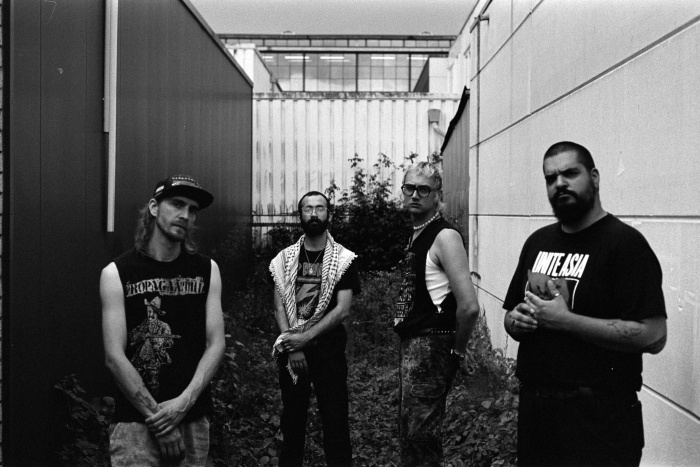
My identity as a Dutch-Pakistani man has been central in Snake Eater from the get-go. Hell, the band's name is even derived from the country's national animal. Within hardcore, I think we are screaming from the belly of the beast. By taking influence from anti-imperialist activists and poets from South Asia and spreading their message in the heart of the empire, we attempt to give this message new meaning and a contemporary audience. With our bassist Ahmad joining the group, we also draw inspiration from his experiences as a refugee and Syrian, and from the Levantine region as a whole.

Al-Hakam is a record that pulls no punches, both musically and lyrically. What real-life events or personal experiences pushed you to write these songs the way you did?
We have witnessed centuries of injustice and suffering inflicted on the Global South by the West and its allies. Snake Eater believes it is of utmost importance to speak our minds about what has been happening for far too long. As I mentioned earlier, our lyrics are inspired by revolutionary poetry from South Asia, which I try to apply to a modern context.
Everything we see today—the occupation in Palestine, multiple genocides happening simultaneously, oppression and censorship, etc., etc.—all has a historical precedent. The same tools of oppression are applied time and again to hurt and subjugate different groups of people. Our songs are an attempt to break the tools in the oppressor's belt, or, at the very least, to raise awareness of their existence.
Hardcore and activism have always gone hand in hand, but Snake Eater seems to take that connection further. How do you see your role as a band when it comes to building solidarity and supporting movements outside of music?
Our music is a form of activism, and I definitely think it's an important side of activism. However, I don't think that's enough. Getting up on a stage and screaming about revolution and the struggle for justice is one thing, but without any tangible efforts to back it up, it feels like empty posturing. I don't want to tell people to get out on the streets and fight the good fight while I sit in a green room napping. If we're talking the talk, we gotta walk the walk, you know.
So, since the start of Snake Eater, we've been trying to support causes beyond hardcore and music. We organized benefit shows for Palestine and our dear friend's legal fees, played other benefit shows for Palestine and political prisoners in Greece, and are currently working on a way to donate to a school for low/no-income kids in Lahore, Pakistan.
I think my family is Snake Eater's greatest inspiration when it comes to our activist side. My parents raised over a million euros in a relief effort after the 2005 earthquake decimated northern Pakistan, in my mother's words, "because it was the right thing to do." My uncle opened and runs the school I mentioned, which doesn't charge an admission fee, so kids whose parents have no money can get an education and hopefully lift themselves out of poverty. My family has always stood for justice and helping those who were dealt a shit hand in life. I refuse to sit idly by while people are suffering. I cannot live a life of luxury while people are starving.
You've been helping raise awareness and support for The Struggle in Pakistan. For readers who may be unfamiliar with the organization or the realities workers and students there face, what do you think people should understand about the situation on the ground right now?
The thing people in the West don't understand is how little they have over there. Growing up, I dreaded going to Pakistan because it meant confronting extreme poverty and exploitation. Kids with severed appendages begging for scraps on the streets, hijra asking you for money—it was a lot to take in for a kid growing up in the West. But it taught me that the life we live here is the exception. The global majority lives like what I see in Pakistan.
The Struggle is an organization that wants to educate people, show them that a better world is possible, and mobilize them for this cause. But they have no budget whatsoever. Even things as simple as printing pamphlets or getting their hands on books are great hurdles for them. You need to understand that our daily wage is their monthly or yearly wage. So any small amount of money we can get them will make a big difference.
We ran a T-shirt campaign where 5 euros were donated to The Struggle for every shirt sold. This money will go toward printing books by Marxist authors, which will help them educate themselves and others, and hopefully further mobilize the people there.
You bring up topics like labor struggles and anti-imperialist politics that rarely get talked about in hardcore. How have people responded to these conversations at shows or online? Any moments that stand out to you?
We've had mostly positive responses, luckily! I think we discuss themes most people are familiar with, but place them in a new context and apply the ideas to a different situation.
Political engagement, in our experience, is currently more of a crust-punk thing than hardcore, so I think people have been exposed to these ideas before. But we believe hardcore needs this political edge too.
One conversation I had that stands out to me was at a benefit show for Palestine. After our set, a visibly drunk guy came up to me wanting to discuss identity and exploitation. In the beginning, he didn't understand why I viewed the exploitation of people in the Global South as different from the exploitation of the working class in the West. Even though he was intoxicated beyond normal functioning, I like to think he learned a thing or two from that conversation [laughs].
What's coming up for Snake Eater? Are you working on new music, planning shows, or looking at other ways to support the causes you care about?
We're always cooking! We're currently on a bit of a summer break, so we're focusing on writing new tracks, but we're always looking for opportunities to play live. That is the best way to experience Snake Eater, in our opinion.
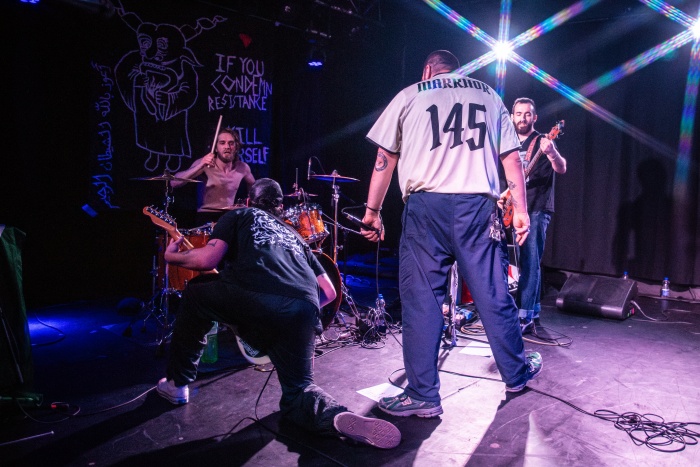
There are bands you listen to on record and are blown away by, but live, their performance falls a bit flat. I believe—and hope—that the opposite is true for Snake Eater. We want you to feel the unbridled rage of the Markhor as you watch us on stage.
Hardcore scenes often focus heavily on North America and Western Europe. What are some bands, artists, writers, organizers, or movements from Pakistan that you think people should be paying attention to right now?
If I'm honest, I don't think I'm the best person to ask this question! I think a lot is bubbling in the underground in Pakistan right now, but as I didn't grow up there, I don't have many connections beyond my direct family. However, a lot is happening in the wider International Brown Hardcore Network, as I like to call it.
First and foremost, I have to shout out Doğa Sultan and her project Antipode, who has created so many connections and continues to inspire all of us in Snake Eater, but also beyond. Secondly, check out ZALZALA, a collective I am part of that aims to give a spotlight to bands and artists with backgrounds in Southwest Asia, North Africa, and further. We're organizing the first edition of ZALZALA FEST this November, which will feature some of my GOATs on the bill.
Looking beyond hardcore, read anything written by Faiz Ahmad Faiz, Habib Jalib, and Muhammad Iqbal, and listen to Iqbal Bano. Without their artistry, there would be no Snake Eater.
***
Snake Eater on social media: Instagram

Tagged: snake eater