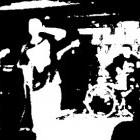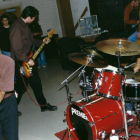

Grail Guard see the present UK as a mirror of punk’s early days. Nearly 50 years on, the problems that shaped the scene remain stubbornly familiar.
Frontman and lyricist Riaz isn’t dealing in abstraction. His words come from lived experience, shaped by growing up as a British, Indian Muslim in a working-class Midlands town, where racism wasn’t theoretical—it was part of everyday life. “I went to a predominantly white school, and I was one of only a handful of people of color,” he says. “On top of that, I was regularly seeing things like the National Front marching through town. That kind of environment stays with you.”
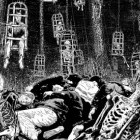
Grail Guard’s debut album, Still No Future, is grounded in lived experience. The record draws a straight line from the late 1970s, when punk emerged amid political unrest, to today’s rise of far-right movements, misinformation, and economic inequality. For Riaz, the world now feels much like it did then.
For Riaz, punk and hardcore were never just about sound—they were a lifeline. Discovering bands through skateboarding and mixtapes, from Minor Threat to The Clash, gave him an outlet at a young age. “Starting a band at 14, with absolutely no idea what I was doing, was elating,” he says. “Punk felt like the one place where anyone could do anything, and that included me.” That sense of possibility coexisted with a constant awareness of being different. “Some people were genuinely welcoming… but you never fully forget that feeling.”
That duality still defines his experience in the UK hardcore scene today. While he speaks highly of the community and the people he’s met, he’s also quick to point out its contradictions. “I’ve definitely had moments that reminded me that not everyone lives up to the ‘unity’ message they shout about,” Riaz says, citing everything from passive-aggressive comments about not drinking to assumptions about his beliefs as a Muslim. “It’s not perfect, but there is definitely a majority of people who are trying to make it better.”
Still No Future puts those contradictions front and center. The lyrics confront imperialism, insomnia, systemic inequality, and racism within the scene. At its core, the record is about seeing the same patterns repeat, even as the details change.
If the late ’70s were defined by unrest and disillusionment, Riaz sees today’s climate as even more volatile. “Anti-immigration sentiment is still rife, but it’s on a much wider scale now with the way the internet is used,” he explains. “You’ve got bot accounts and online campaigns designed to stir up hate, and people fall for it constantly.” Add in the growing influence of far-right politics and media narratives built on fear, and the parallels become harder to ignore.
For someone who has been active in DIY punk, socialist, and anti-fascist movements since the late ’90s, the role of hardcore as a vehicle for change is still very real—but conditional. “At its best, punk and hardcore give people a voice, build community, and push back against hate,” Riaz says. “The message only matters if people actually live by it.”
That urgency has only deepened over time. Now a parent, Riaz is watching his daughters face the same kinds of prejudice he experienced growing up. “My children have been targets of racial bullying, and that hits differently,” he says. Moments like his daughter having her hijab pulled off at school aren’t just isolated incidents—they’re reminders that these issues are generational. “It reminds you that none of this is new.”

Still No Future is meant to provoke, but also to clarify. The album cuts through distraction and misdirection, showing how division keeps people from challenging the systems that shape their lives.
Onstage, that clarity becomes something else entirely—a release. “Being on stage and singing about these things helps my mental state,” he says. “It gives me somewhere to put all that anger and frustration.”
***
Still No Future is available on vinyl now via TNSrecords.
Grail Guard on social media: Instagram

Tagged: grail guard