
“We’re huge in Europe right now…a big record just broke in Belgium.”
These were the words uttered by fictional musician Cliff Poncier (portrayed by Matt Dillon), of the fictional rock outfit Citizen Dick (members played by Stone Gossard, Jeff Ament and Eddie Vedder from Pearl Jam) in the 1992 grunge-inspired motion picture, Singles.
While that bit of cinema was enjoying moderate success in American movie theaters, thousands of miles away across the Atlantic - from the United Kingdom, throughout Europe and all the way to Russia - a different sort of musical phenomenon was beginning to take hold and shine brightly: New York Hardcore. Yup. The hard-as-nails, oft misunderstood punk-inspired sound of the NYC streets was creating a stir with European punks squat by squat. Just a bit later, the continent’s metalheads jumped aboard as well.
The seeds of punk rock, along with its uber rebellious ideology, came to the surface in America during the mid-'70s, yet it wasn’t long before the youth of the UK and continental Europe applied this new racket to their own disaffected predicament. After all, America wasn’t the only place where young folks had a hard time finding work, hated the government, were pissed at their parents and had little interest in walking in step with society.
On the lower east side of New York City at the dawn of the 1980s, the overall condition was decidedly dire. The economy was in the toilet; the crack epidemic was kicking off and kids were simply trying to find their footing. The punk rock scene from half a decade earlier, which had semi-eloquently yet forcefully spoken for the youth, was done. No longer did The Ramones, Dead Boys and the Heartbreakers rule the roost in the city which bred them.
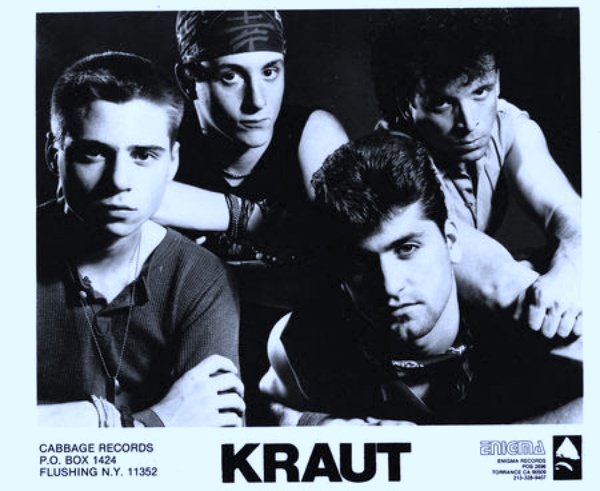
Thankfully though, a new noise was a brewin’, and its acronym was NYHC. Bands with names such as Kraut, The Abused, Heart Attack, The Stimulators, The Mob and Reagan Youth popped up with a harder, faster, grittier and more urgent presentation than its punk predecessors.
The look of New York City hardcore boasted a sharper edge too with shaved heads, boots and often some sort of accessory which could double as a weapon should the need arise to possess one, and rest assured, back then, it often did. Many of the movement’s participants were street kids seeking a release from their own troubled lives. The scene was as volatile as it was creative and exciting.
READ MORE: In-Effect: Learn the Story Behind the Influential Record Label
By 1984 - certainly 1985 - the gospel of NYHC had spread abroad thanks to a handful of bands, namely: Agnostic Front, Murphy’s Law and Cro-Mags. Each produced recordings which gradually made their way into punters’ hands many thousands of miles away, and the groups began touring beyond the convenient Northeast states. Be that as it may, notoriety was also gained in part courtesy of the bible of hardcore punk of the era: the Bay Area based mag, Maximumrocknroll.
For better or worse, Maximumrocknroll was punk’s CNN, Wall Street Journal and some sort of weird communist worker’s paper all rolled into one. It was PC to the fullest, and established its own rules, which many in the punk world questioned. Nonetheless, MRR was widely consumed, wielded a great deal of influence and its readers the world over took the content within its pages very seriously.
For various reasons, none of them particularly good, Maximumrocknroll hated New York Hardcore. Hated it! Within its monthly scene reports, as well as other editorial, the ‘zine treated NYC like a hotbed of skinhead violence, complete with unprovoked attacks on fans and bands alike as well as other assorted ignorance. Where MRR received its “facts” remains a question to this day, and no one saw any of their “journalists” anywhere in the city.
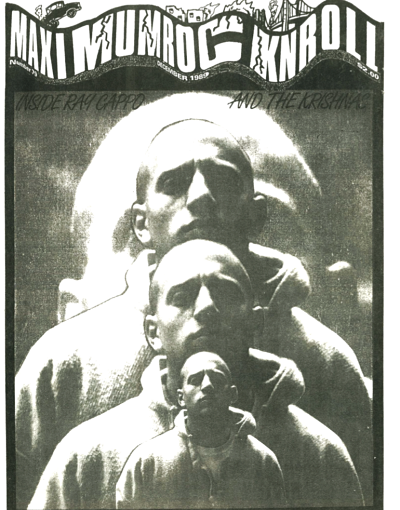
Bands like Agnostic Front in particular had to live down a lot of vicious rumors and bullshit during their early tours of the U.S. and fans overseas had no alternate point of reference with which to dispel these (false) notions. Euro punks had yet to see the New York bands as there was only a primitive touring network established between the continents.
Maximumrocknroll made New York a villain, however they failed to realize just how much people love a good villain. The mag’s rhetoric brought a lot of eyes to NYHC, so with their backs against the wall, and a lot to answer for, the New York acts found its allies across the pond and hit the road to let ‘em know who they truly were.
The scene’s primary ally was Marc Nickel who runs M.A.D. Tourbooking based in Berlin. He was the first and most deeply invested promoter to bring NYHC groups over to tour Europe. He too knew the reputation that preceded the bands thanks to Maximumrocknroll, but Marc had spent some time in America, particularly on the aforementioned lower east side, going to shows and meeting the bands and scenesters. He quickly chose to put his money and reputation where his mouth was. It was time for Europe to get its taste of raw, unabashed New York City hardcore.
Ladies and gentlemen, meet Marc Nickel:
"I grew up in West Berlin where the Berlin wall cut through and surrounded us with barbed wire and watchtowers. There was a kind of insular mentality here for quite a while. But as a frontline city, this brought us some advantages. Clubs and bars were open 24/7 and we were known worldwide as a party city that brought many international stars to Berlin. All the artists, deserters and draft dodgers flooded West Berlin. In the late 60´s and 70s, into the 80s, student unrest and squat riots were heating up in what was already a very political city. West Berlin’s over 200 squats were a perfect playground for urban adolescents.
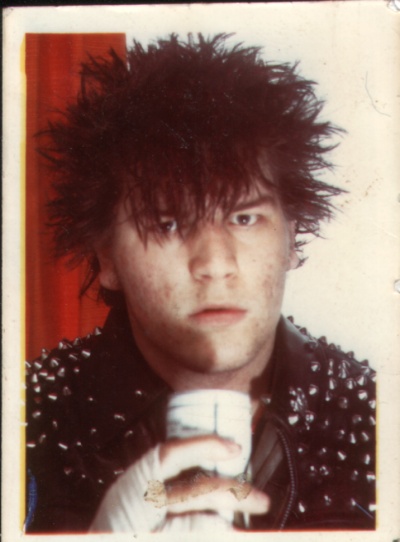
"I was raised on glam rock and just rock like Slade, T-Rex, The Sweet, Deep Purple, Black Sabbath etc. like most people in the early 70's. It was about escaping society and breaking the rules. I had some older friends in my neighborhood who were kind of the first wave of punks and skinheads - the weirdos, outcasts, rebels and the hooligans. That drew me into punk around 1978.
"It was a new soundtrack coming from England with the Sex Pistols, Clash, Damned, etc. It was the sound I was waiting for. But that first wave of English punk rock eventually became commercialized, and the bands fell apart, so around ‘79/’80, the second wave came even harder sounding and looking. Plus, the American punk rock was now coming too. New networks were being built, record stores were popping up… People in Berlin were pioneers of all of this in Europe. We were a small scene at that time, so people all knew each other and cooperated with one another.
"Bands like Dead Kennedys, Black Flag, Minutemen and MDC started to play live in Europe. I had a friend who did some of the first shows and records for these acts here around ‘80/’81 and got some early insight. Suddenly the music changed from 'punk' to 'hardcore' with the release of D.O.A.’s 'Hardcore 81.' Nobody here could explain the difference musically between hardcore and punk, but I never cared. For most people in Germany, it was European music: punk, everything from America: hardcore.
"In the beginning, there was only a very small fanzine scene in Germany, but flyers, of course, were common and all over the place. We didn't have any radio that played punk or hardcore. This music was only played on the English Army Station of the BBC hosted by John Peel, which was broadcast at night. That’s how we heard first of bands like SSD and Minor Threat and tried to get our hands on those records. As time progressed, the subculture scene started exploding.
"Now we had some of our own radio late at night on a special youth format. Other German radio followed in West Berlin, for example, the S.F.B. (Radio Free Berlin) and Radio R.I.A.S. (Radio in American Sector). We sat with our cassette recorders in front of the radio and recorded the shows, then exchanged the cassettes with others later on. It was still hard to find the records in any stores.
"By around 1985, the fanzines began to have a bigger impact here. A lot of them were heavily influenced by, or were simply copying Maximumrocknroll, but we also got (U.S.-based ‘zines like Flipside, Suburban Voice, and XXX, plus some others that expanded the musical horizon. I was helping a friend here with one called Hardcore which was mostly focused on American bands and fanzines. He translated everything into German. It covered bands like Bad Brains, Meatmen, Minor Threat, SSD, Gang Green, Hüsker Dü… It was all to help spread the word of these bands.
"Eventually, in 1982 I think, my partner Ute and I booked our first concert together which was basically the beginning of M.A.D., although we had no name at the time. We sort of stumbled into what we loved. It grew from our do-it-yourself punk ethic. A couple of years later, the shows we did went bigger and bigger all over Europe and it developed into a full time job.
"We loved the music and the people and wanted to bring the music we liked to Europe. At that time, outside of the European bands, the groups from D.C. and California were dominant here, and began to come over pretty regularly. We became friends with them, did the shows and loved what they did, and we were able to build a solid, consistent, reputable business.
"We not only booked the bands’ shows, but we also had to get everything organized for them. They didn’t know how to buy airline tickets, or have road crews, vans, backline, even artwork for t-shirts. We did everything for our bands and created a network all around Europe that developed around the bands. Of course, we were not alone, but the motor of creativity, inspiration and breaking the rules… We loved what we were doing and still do today.
"We didn’t start out booking New York bands; this came later, but we clearly loved the music from the streets of NYC. It was as much about the people as it was the music. But NYHC was burdened by a lot of fake news thanks to Maximumrocknroll. Don't get me wrong, the magazine and Tim Yohannan’s work was super helpful for this growing the worldwide hardcore punk network. It let a lot of people know what was going on. At first it was inspiring, but after some years, it became disillusioning.
"For whatever reason, Maximumrocknroll had a terrible impression of NY and its hardcore scene. For example, I was hanging out in San Francisco in ‘87 in the Maximumrocknroll office around the time the first Sick of It All EP came out. RNR had gotten a copy for review, and they handed it to me right away, saying, “You like this macho New York bullshit” or whatever. I said sure. That’s how I got their Revelation 7”. They did me a favor.
"The main German fanzines took MRR’s words with its many prejudices as fact and spread what they were saying like it was absolutely true. While I was spending time with the MRR people and hung out with Tim, we had a lot of interesting conversations about politics in Europe and the big differences in approach and implementation between the scenes. But it was always a one-way discussion. I told them, “You’re fighting for and preaching these ideas, but all you do is attack New York when you have big problems with fascists right here (in San Francisco). It was very hypocritical.

"Europe’s squat punk scene was so much closer to the vibe in New York City back then, which a lot of people didn’t realize at the time. We had very active anarchist circles in Germany; riots with cops... Agnostic Front, Murphy’s Law, Cro-Mags, Sick of It All - many of us in Europe had the feeling that these people and these bands were a lot like us European punks and had the same feelings and thoughts about revolution, and trying to change the world into a better place, and not just talking (about it). They would all step up against right-wing politics and racism face to face and not just sing about it. Not to forget that the power of their music carried everyone away.
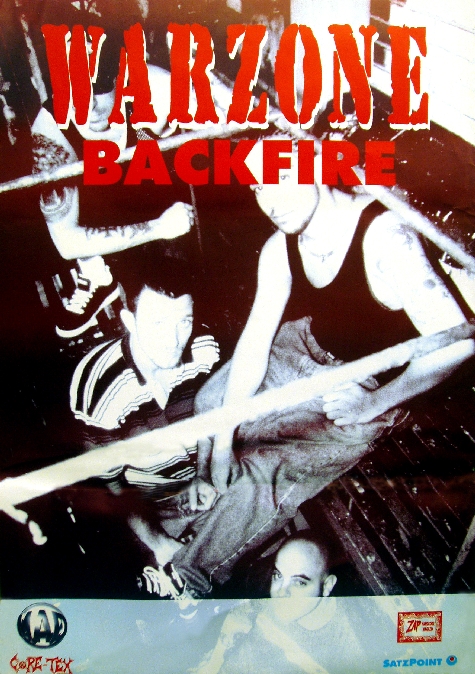
"When I first went to New York, I actually didn't know what to expect because of what I’d seen in Maximumrocknroll. I went straight from the airport to (infamous NY punk hangout) Tompkins Square Park. I didn't know anybody in New York; I just walked up there with a sleeping bag on my back. (Longtime Agnostic Front roadie and friend) Frenchie da’ Skin was sitting there and welcomed me with open arms because I told him why I came. I slept in some squats with rats on the floor, with some of the early Warzone Women.
"I met Raybeez from Warzone and everybody running around there, and the first thing I thought was, “Wait a minute, everybody's together here. They don't care if you like metal, have long hair, short hair, are a skinhead or a punk. It's like one huge family.” All these kids, especially the lower east side kids, lived in fucked up squats and buildings most Europeans would never squat in. When I went to the first show in NYC, people were white, black, speaking Spanish and I was like, “Whoa, it's like another world.” Where I came from, basically everyone was white.

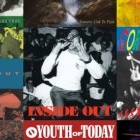
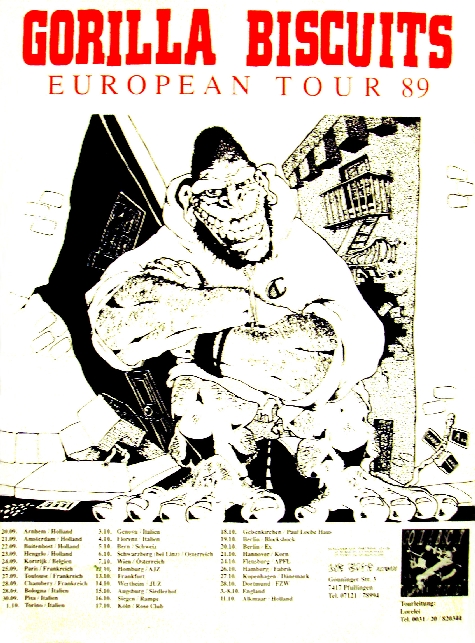
"After a bit of time, we brought over Gorilla Biscuits, Youth of Today, BOLD, and Shelter. It gave us headwind with a European scene that was not actually ready for straight edge or the youth crew movement…the anti-punk thing. And from another corner, we got a lot of fake news about the bands and New York and all of that.
"We had a lot of work to do and had a lot of discussions with people to dismantle all the bullshit, which is unbelievable when you look at it now and see how far the bands have come. Now everything is forgotten and just normal, but many people here were convinced these bands were violent, right-wing assholes which had to be corrected within the scene and those who booked bands.
"With every fake news story that we were able to correct, the support of the people grew in Europe from show to show. The bands played squats or at political festivals against racism and fascism. At first, the NYHC bands compared to those from other scenes in the U.S. weren't really well off and were distrustful of outsiders. Most had never really left New York besides maybe playing City Gardens in New Jersey, or the Anthrax in Connecticut. We had to find a way to pre-finance their flights so that they were confident to leave New York without a lot of risk.
"But don’t kid yourself, despite how it is now, most of the bands played for very small audiences outside of Berlin or like, Bologna, Italy. Those were the hotspots at that time. Especially Berlin, all the NYHC bands would play to say, 150 people throughout Europe, but in Berlin, at the SO36, it would be sold out with 1000 people going crazy.
"Later, when the eastern part of Germany came into the picture, cities like Leipzig, or Chemnitz or Lugau became great for the New York bands. Most agents in Europe as well as the bands were full of prejudices concerning East Germany after the reunification in regard to violence and right-wing attacks. This music was for sure far less commercial back then, so mostly only bands from M.A.D. played in East Germany. We were not afraid of anything and supported this new growing scene over there.
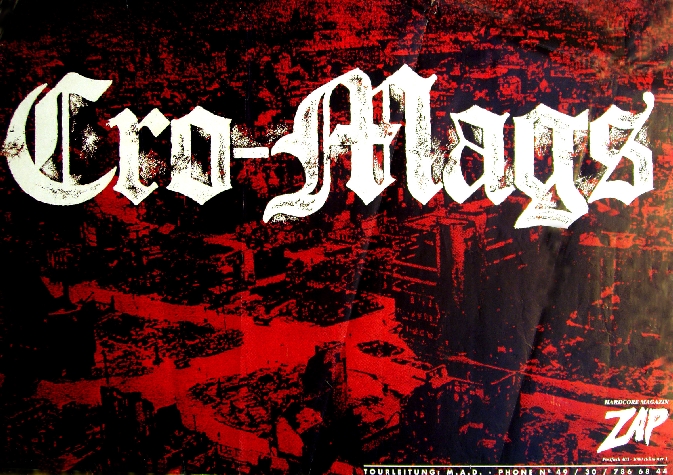
"Our bands trusted us and NYHC dominated the new territories. Same with the eastern European markets. It was such a complex and intense time. I should also mention that the Germany fanzine Zap had been launched by a close friend in Germany and they pushed and celebrated the NYHC scene which they understood better than MRR. It was the first helping hand for a lot of smaller acts to tour Europe.
"We still had to fight some of the prejudices which were still working against NYHC, but the political punk scene: the anarchists and ANTIFA groups we had in Europe had a lot of supporters for the NYHC scene which was very helpful, and we got a lot of back-up from those corners.
"Something unbelievable that happened as far as the European breakthrough for New York hardcore and gaining a wider audience was our ability to get our bands on the big festivals in Europe. It made a huge difference, and a few of the bands just exploded. Our early work with the bands had laid the foundation for the next step. Reaching those first few festivals here like Dynamo Open Air in Holland, and Grass Pop Metal Meeting and Midsummer Metal Meeting in Belgium... While the ice was not exactly “broken” yet, more and more festivals opened the door for NYHC bands."
Lou Koller - Sick of It All:
"That was just crazy. We’d played some pretty big shows before Dynamo; the biggest being maybe a thousand people, but nothing like this. It was just heads as far as you could see. We weren’t sure if any of the people there would know who we were, but a lot of them did, and we won over the rest. Dynamo was actually the first show of our tour that year and we had a truckload of shirts and stuff. We sold our entire tour’s worth of merchandise that day, and we weren’t sure we were going to sell any at all because of the prices. We were used to our “hardcore” merch. prices, not big festival prices set by whoever the headliner was."
Marc Nickel:
"It was unimaginable at that time for bands like Sick of It All to play in front of 100,000 people on a main stage. It was largely due to the friendship and good relations we had all created over the years, us and the bands. I mean, these NYHC acts were sharing the same stage with Guns ‘n’ Roses, and Scorpions, and Judas Priest and KISS.
"Even SOIA’s manager at the time could not believe that such a thing existed, and wasn’t supportive of them playing Dynamo, but the band confirmed it anyway against his will. The manager had no idea what we were building up here and what our networking had created. Sick of It All, Agnostic Front and Madball took the festival stages by storm and opened the door for all the others. They went from playing for 80 -150 people in youth centers and squats, to a crazy number of people each summer.
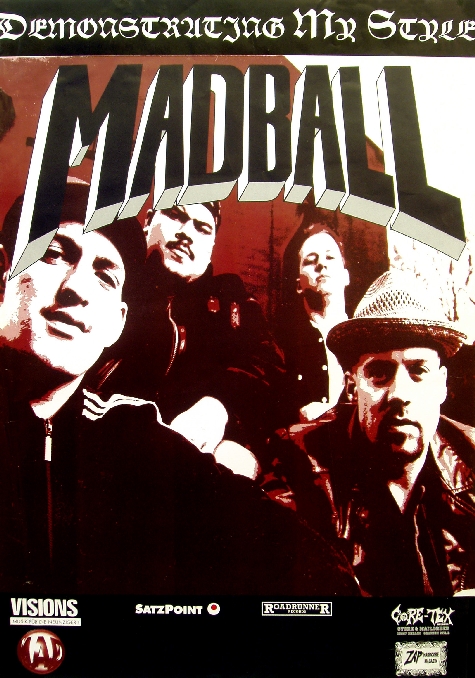
"We worked so hard to make that happen for the NYHC bands step by step. We didn’t have any real hype, or mainstream label or press support. It did become a bit easier later on with festivals in Europe for punk and hardcore when California punk rock like Green Day and Offspring went mainstream in the '90s, helping propel the scene into the spotlight.
"NYHC wasn’t quite this lucky of course, but a label like Roadrunner Records signed some New York hardcore and a few metal bands in the '90´s that went on to be very big here, mainstream even. AF, SOIA, and Madball went their own way. They had everyone’s respect. They looked after themselves, and we looked after them. They carried the weight for so many other bands, and not only succeeded, but made it possible for every remotely hardcore sounding band to appear on festivals in Europe. I’m still kind of amazed by the whole situation."
Tagged: sick of it all